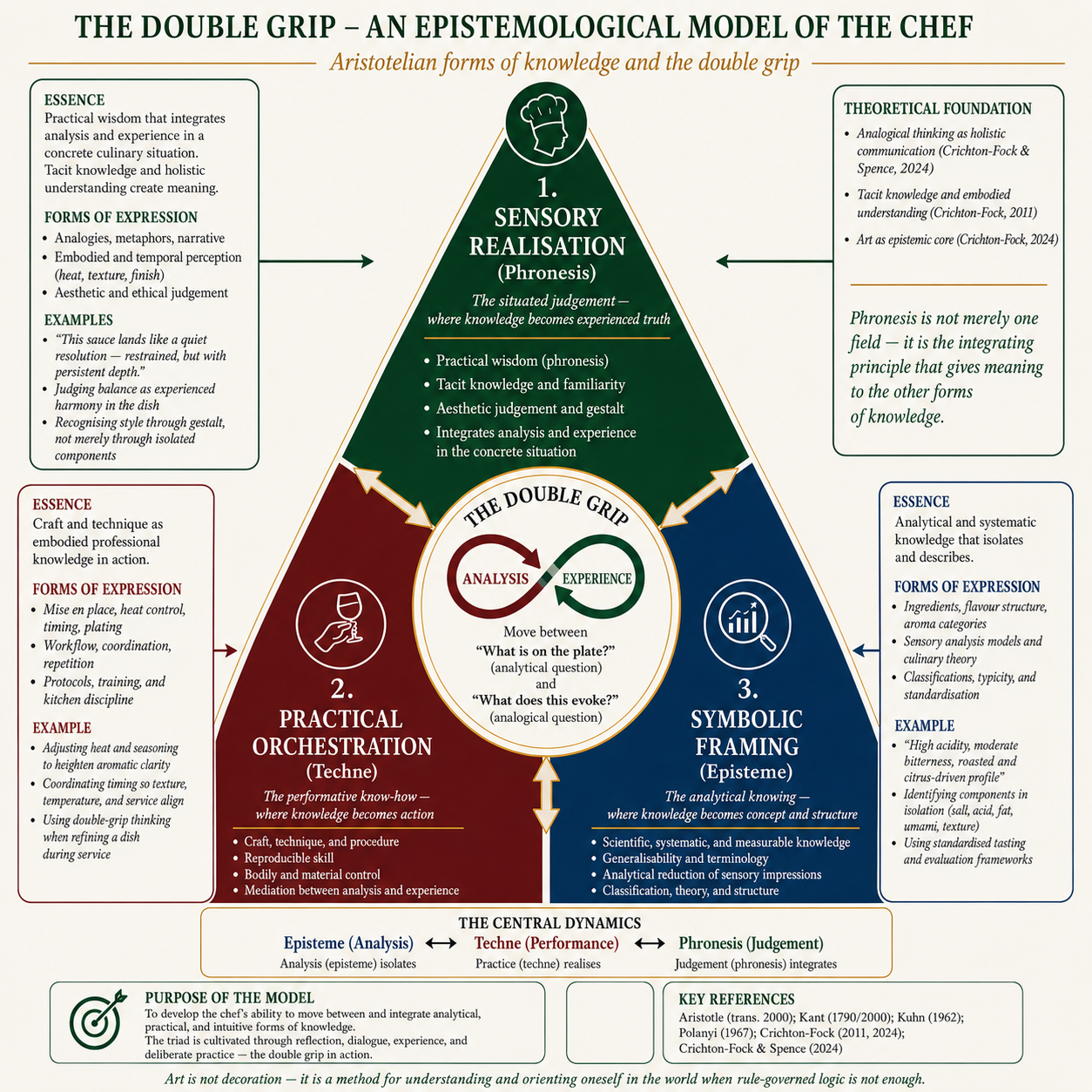
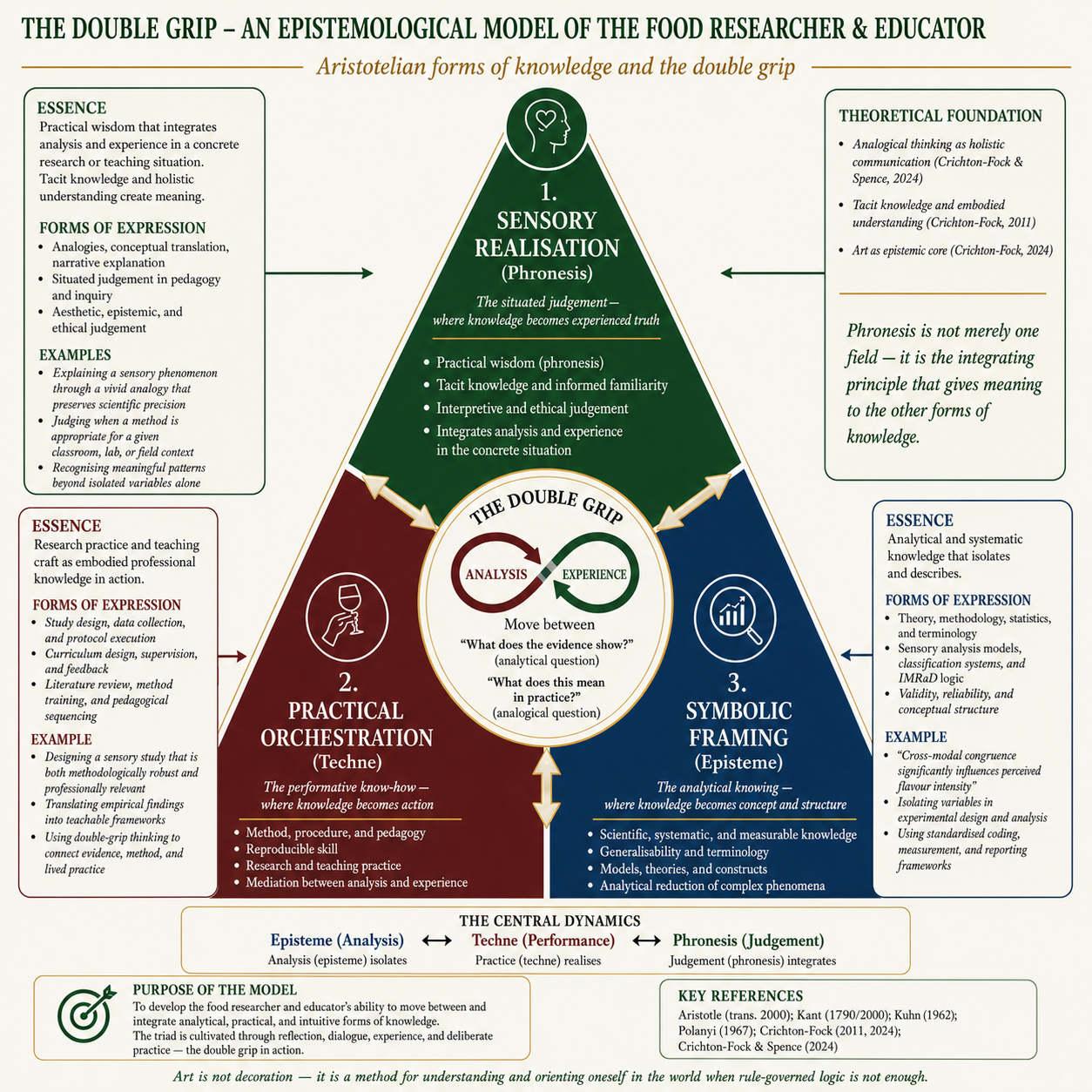
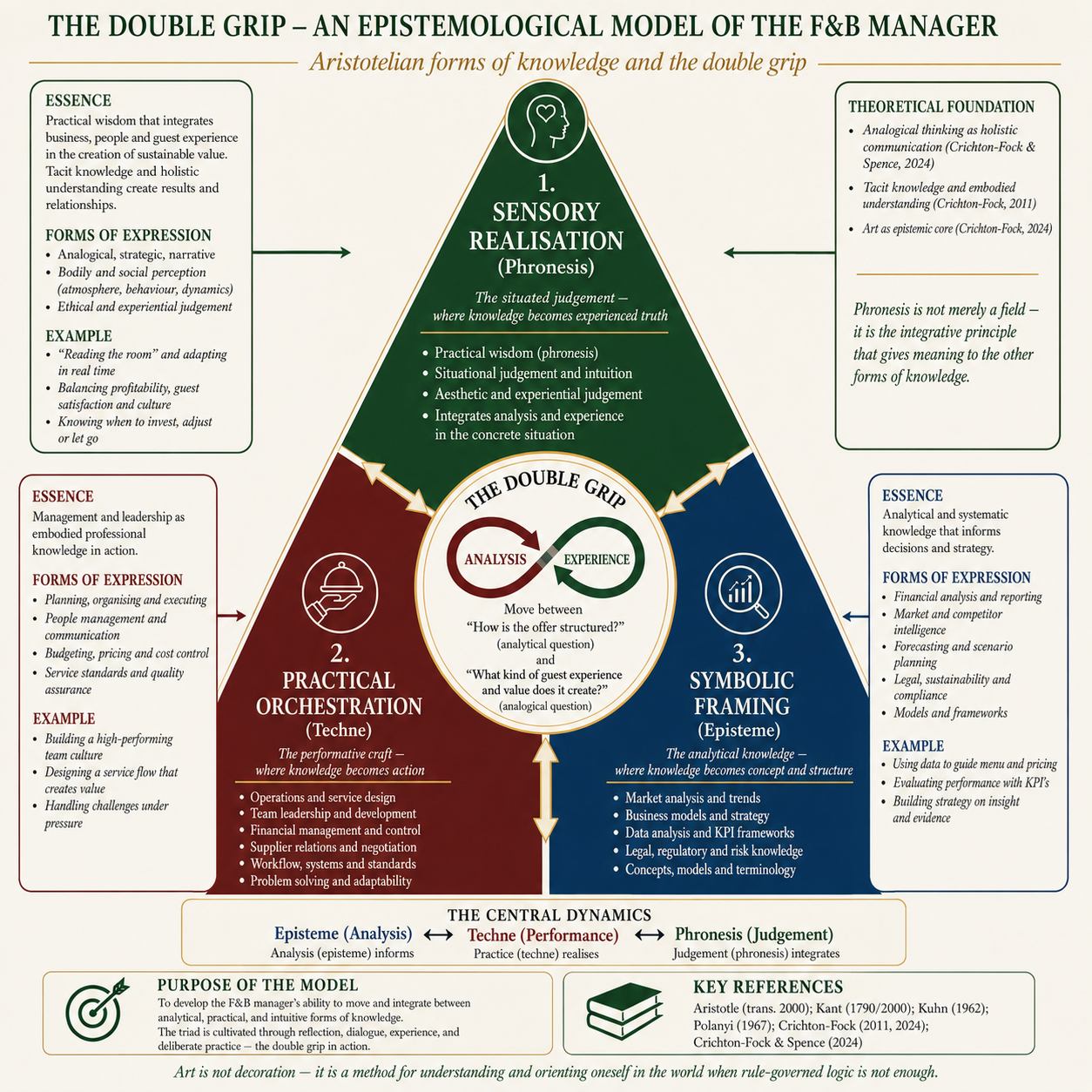
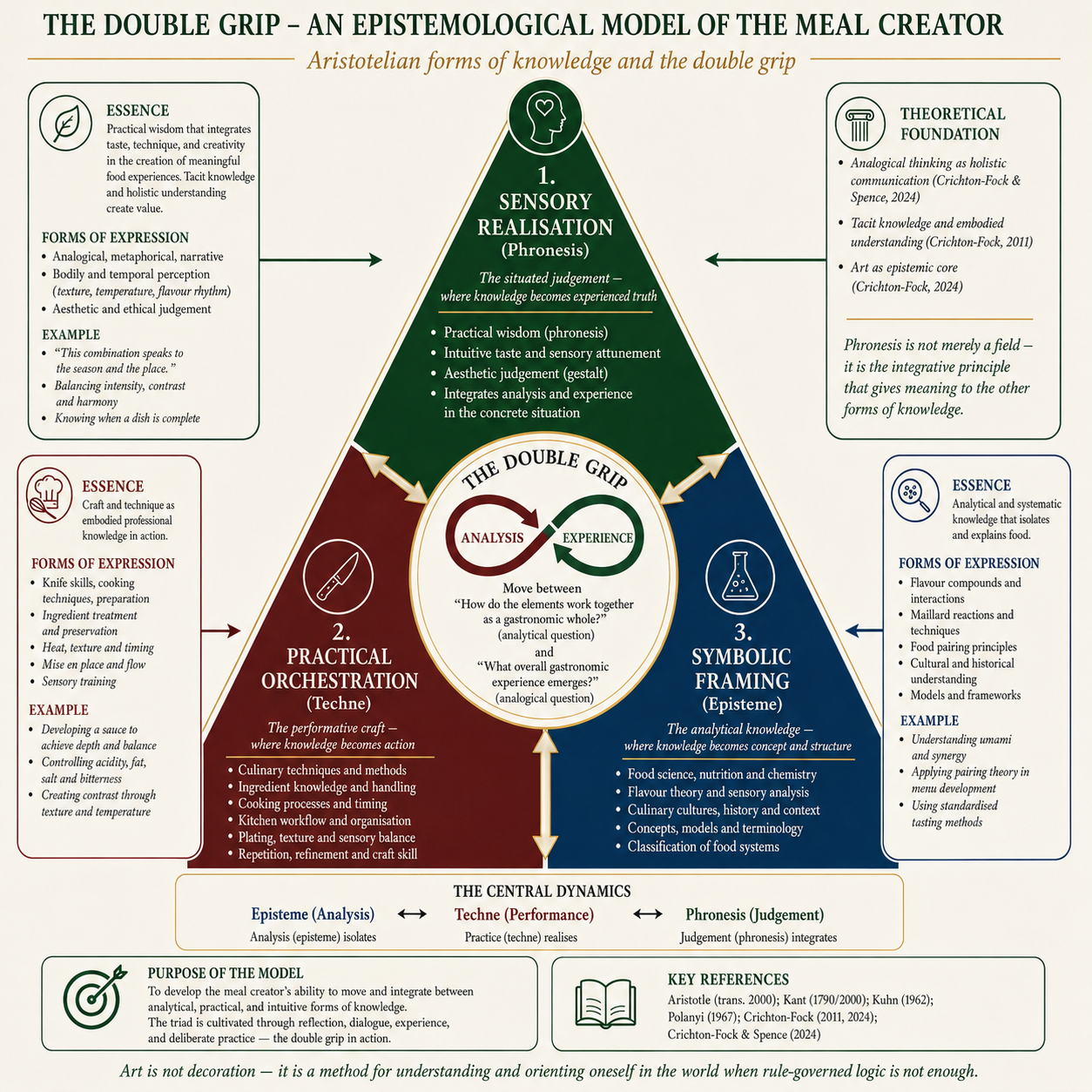
From Aristotle to Crichton-Fock — the intellectual sources and interpretations the TRIAD model draws on. TRIAD is a modern application of a small selection of these sources; the framing is ours, not theirs.
Two sides of one coin. Science and art hold the same knowledge but give it different form. Science moves from parts to whole. It generalises, expresses knowledge in attributes and terminology, and values what can be measured, for its precision and repeatability. Art moves from whole to parts. It exemplifies, expresses knowledge in metaphors, analogies and examples, and values the whole, for the shared understanding it builds. The two sets of values cannot be compared, but each needs the other. As Kant put it, thoughts without content are empty, intuitions without concepts are blind.
| Science · episteme | Art · phronesis | |
|---|---|---|
| Thinking | analytical | analogical |
| The case | generalising | exemplifying |
| Direction | parts → whole | whole → parts |
| Expression | attributes, terminology | metaphors, analogies, gestures, examples |
| Purpose | explanation | understanding |
| Value | precision, repeatability | the whole, shared understanding |
| Question | What qualities can I discern? | What awakens within me? |
The grip that turns the coin. Seen face-on, a coin shows only one side. Seen on its edge, it is a line, and in that moment it belongs to both. The line between science and art is the coin on its edge. The Double Grip, techne, is the grip that turns it. The expression goes back to Diderot's Paradoxe sur le comédien (c. 1773): the actor holds reflective distance and expression in the same hand. Techne exists only in doing, so it shares the line with the concrete situation: the grip is exercised where a real question has to be answered. The question decides which side is needed first. The answer is tested in action, and action raises a new question. This movement is abductive reasoning in Peirce's sense: a situation that does not fit what we know produces a hypothesis about what matters.
Why both sides are needed. The approach has been tested in sensory training since 2003. Analogical training broadened the attributes professionals used and built a shared understanding. Analytical training improved how consistently they repeated their judgements (Herdenstam et al. 2018). After analogical training, sommeliers and chefs made more precise assessments, found a common language and judged the same product more consistently (Herdenstam et al. 2020). Neither side replaced the other.
From 2011 to now. In the doctoral thesis (Herdenstam 2011) the Double Grip is the movement between analysis and experience. In the 2023 model it is mapped onto Aristotle: science is episteme, art is phronesis, and the Double Grip itself is techne. Now the line is understood as the coin on its edge, exercised in the concrete situation.
What the app does, and what you do. Gusto Science cannot perform the Double Grip for you. It builds the scaffolding, as a dialogue seminar does.
| The app | You | |
|---|---|---|
| Episteme | states what the study supports | check it against the original |
| Techne | proposes a constructed use situation: an example of the finding in use | perform the grip in your own practice |
| Phronesis | asks questions | exercise judgement |
TRIAD is built to show exemplifying examples. Each analysis puts a finding into a situation where a given professional could use it.
Contextual alignment. Communication works better when it corresponds to the experience it describes (Crichton-Fock, Spence & Pettersson 2023). Gusto Science applies the same principle to research. We call it contextual alignment: presenting a finding so that it matches the situation where it will be used. As Wilde wrote, "to look at a thing is very different from seeing a thing". The example is what lets a finding be seen in practice, not only known.
How we will test it. That the Double Grip works when an app presents research is a hypothesis, not a result. We are testing it in three steps: an A/B test of situational versus neutral presentations of the same finding; a comprehension study with professionals and researchers comparing analytical and analogical presentations; and, if the results support it, a publication. If analogical presentation raises interest but lowers accuracy, that supports showing both sides, not abandoning the model.
A research database is only as trustworthy as the process that builds it. Below is what the pipeline actually does today. Where we do not have validation data, we say so.
Articles are gathered from OpenAlex and PubMed, from a curated set of gastronomy and sensory-science journals and from targeted keyword searches. Fields retrieved: title, abstract, authors, journal, year, DOI, citation count (OpenAlex), institutional affiliations. Full-text is not retrieved.
Every article must carry a DOI. A keyword+journal filter blocks generalist journals and requires a food/wine/culinary signal in title or abstract, or a trusted-journals match. Ambiguous single-keyword hits pass through a separate binary AI check.
Missing abstracts and metadata are backfilled from source APIs so each article carries enough substance to be scored on its content. Duplicates are matched by DOI and by title prefix.
Screening and scoring happen in two separate Haiku passes. First a gastronomy-relevance check (title up to 200 chars, abstract up to 700 chars, journal) decides whether the article belongs in the library at all. Articles that pass are then scored 0–10 for each of five professional roles (title up to 200 chars, abstract up to 400 chars, journal). If the highest role score is 5 or above, the article proceeds to TRIAD analysis.
Qualified articles are analysed through the three lenses — Episteme, Techne, Phronesis — for each profession. A Claude Sonnet model generates the analysis from the title and abstract (up to 2000 chars). Full-text of the source paper is not read.
Curation runs continuously: new research is assessed as it arrives, and earlier judgments are revisited as the method improves. Some relevant work is still missed, and some borderline work is still included. We show the method openly because the integrity of the knowledge base depends on the integrity of how it is built.
The Double Grip — Crichton-Fock's central contribution — holds analytical explanation and analogical understanding in productive relation. Scientific inquiry isolates, measures and compares defined aspects of a phenomenon. Artistic and analogical inquiry can preserve and communicate relations within the contextual whole through examples, scenarios, metaphors, gestures and sensory expression.
Neither mode replaces the other. Analytical knowledge can lose important relations when separated from context, while holistic understanding can become difficult to examine, communicate and justify. Professional knowledge develops through the movement between them.
The Double Grip does not make the immeasurable measurable. It makes different forms of knowledge graspable, communicable and legitimate according to their respective character.
The Double Grip can be read as a constructive development of the tension in Diderot's Paradoxe sur le comédien (c. 1773), which emphasises the accomplished actor's reflective distance and technical control alongside the capacity to reproduce the signs of emotion without being governed by them. Applying this tension to professional practice, and naming it the "Double Grip", is Crichton-Fock's, not Diderot's own terminology.
The Double Grip model ↑The TRIAD model is not an abstract philosophical framework — it is a practical tool for professional development in gastronomy. Developed by Anders Crichton-Fock at Örebro University, it operationalises three of Aristotle's intellectual virtues — episteme, techne, and phronesis — for the lived reality of professional practice: the sommelier at the table, the chef at the pass, the educator in the classroom, the researcher at the bench. TRIAD is a modern application; the selection of virtues and the working glosses used here are the model's, not Aristotle's own definitions.
The double grip — the simultaneous holding of analytical explanation and analogical understanding, two sides of one coin — is the condition of excellence. Not scientific knowledge applied to practice, not aesthetic sensibility informed by science, but both at once: the unrepeatable moment in which the practitioner integrates what she knows, what she can do, and what the situation demands.
Gusto Science is the infrastructure for developing this capacity: a curated body of research, translated into three dimensions of professional knowledge and made available for every profession in gastronomy — so that the practitioner can build the knowledge base from which excellence can grow.
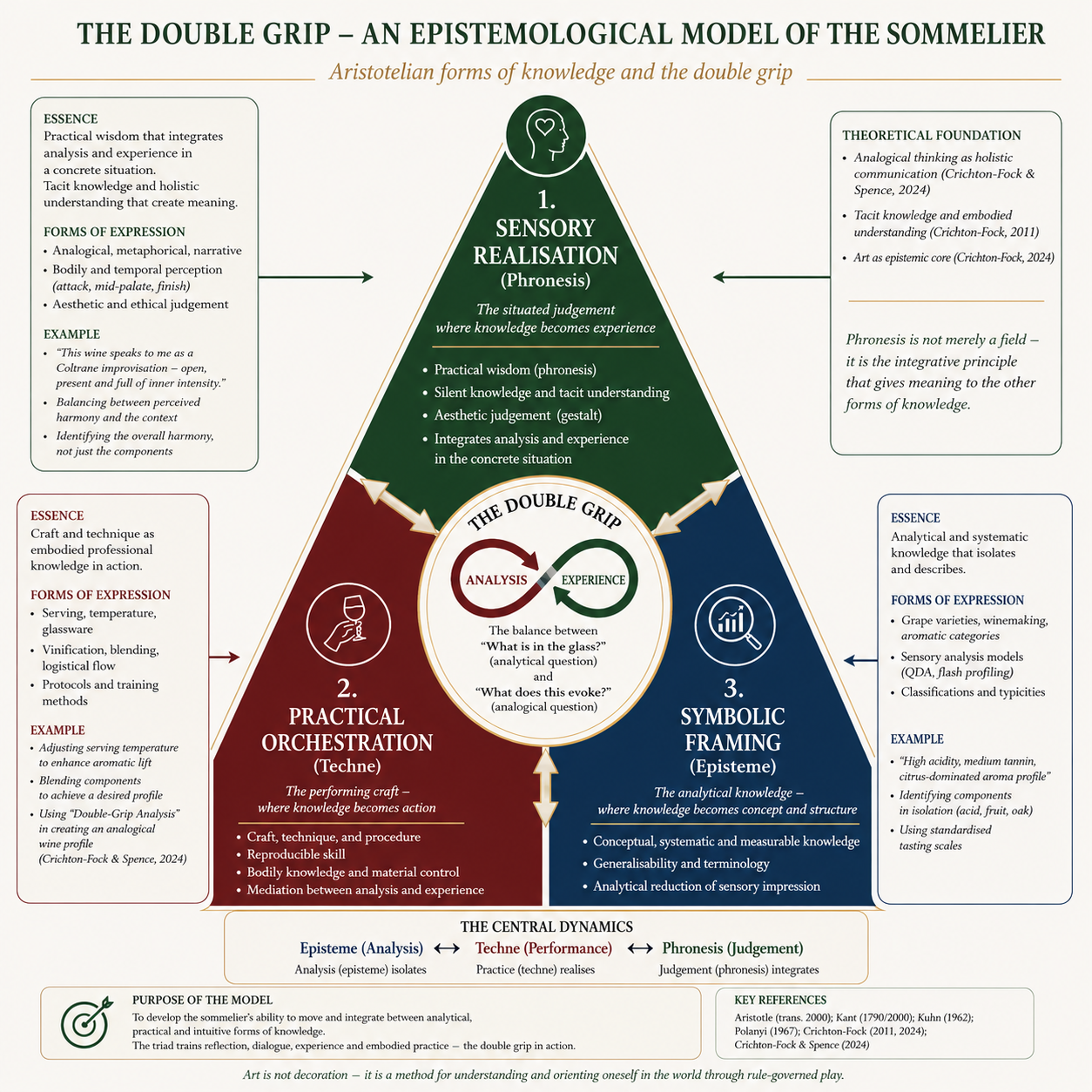
Gusto Science reads each paper's title and abstract through three lenses drawn from Aristotle's intellectual virtues, operationalised by TRIAD. The three lenses have different epistemic status: what the research supports, what a professional could do with it, and what still requires the practitioner's own judgment. They are not three equally certain answers to the same question.
These are two registers, not two levels of abstraction. Sensory analysis is experience-based knowing; conceptual explanation is explicitly articulated knowing. Neither is more "abstract" than the other.
In the Double Grip model, episteme is associated primarily with deductive and demonstrative reasoning; phronesis develops through experience, comparison and situated judgment; and techne often involves abductive movement between knowledge, material conditions and possible action. These are operational associations within the model, not exhaustive historical definitions of deduction, induction and abduction.
Aristotle. (trans. 2000). Nicomachean Ethics. (R. Crisp, Trans.). Cambridge University Press.
Beckett, S. (1983). Worstward Ho. Grove Press.
Bourdieu, P. (1980). The Logic of Practice. (R. Nice, Trans.). Stanford University Press.
Crichton-Fock, A. P. F. & Spence, C. (2024). The imitation game — exploring the double-grip analysis for creating analog wines. Journal of Wine Research, 35(2), 139–159.
Dewey, J. (1934). Art as Experience. Minton, Balch & Company.
Diderot, D. (1773/1957). The Paradox of the Actor. (W. H. Pollock, Trans.). Hill and Wang.
Herdenstam, A. P. F. (2004). Sinnesupplevelsens estetik: vinprovaren, i gränslandet mellan konsten och vetenskapen [Licentiate thesis]. Stockholm: KTH.
Herdenstam, A. P. F. (2011). Den arbetande gommen: vinprovarens dubbla grepp, från analys till upplevelse [Doctoral dissertation]. Stockholm: KTH.
Polanyi, M. (1966). The Tacit Dimension. Doubleday.
Schön, D. A. (1983). The Reflective Practitioner. Basic Books.
Turing, A. M. (1950). Computing machinery and intelligence. Mind, 59(236), 433–460.
von Wright, G. H. (1971). Explanation and Understanding. Cornell University Press.
Weil, S. (1947). Gravity and Grace. (E. Crawford, Trans.). Routledge.
Wittgenstein, L. (1953). Philosophical Investigations. (G. E. M. Anscombe, Trans.). Blackwell.
Research is undertaken to change the world. Yet too often it stays in the university, at a distance from the society it means to transform.
Citation counts and the h-index reward academic standing — not whether knowledge reaches the kitchen, the cellar, the dining room, or the producer, and changes how someone perceives, decides, and acts. This is not only a problem of communication. It is a problem of what we let count as knowledge.
Aristotle distinguished several intellectual virtues; TRIAD selects three that speak directly to what a reflective professional needs:
The metrics see only the first. Techne — the reflective knowledge of practice — and phronesis — the situated judgment that discerns the right action when no rule suffices — are precisely the forms that resist measurement. As Polanyi observed, we know more than we can tell. The taster's discrimination, the cook's hand, the host's read of a room: real, transmissible knowledge to which the strict demands of reliability and validity simply do not apply — yet which is often what matters most in judgment, in action.
Crichton-Fock's Double Grip is a constructive development of the tension Diderot dramatised in the actor: analytical control and sensory-aesthetic involvement, held together rather than alternated between. Analogical inquiry — through examples, scenarios, gestures and sensory expression — preserves relations that analytical inquiry, when it isolates and measures, can lose. And gastronomy is where the stakes are sharpest. It is the one art that engages not only sight, sound, and texture, but smell and taste. Its knowing cannot be gathered from reading alone; it becomes only when all the senses are present together, in the act, judged as a whole.
The TRIAD is an infrastructure for that alignment. By reading research through episteme, techne, and phronesis for each profession, it creates contexts in which practitioners can take up important knowledge without it losing scientific dignity — and in which researchers can see the interdisciplinary connections that complex human situations demand. That is why the map of connections exists: not as ornament, but as an instrument for seeing where fields must meet.
This is not an unbroken historical genealogy. It is TRIAD's reading of a small number of thinkers, arranged to show which resources the model uses and how. Each source is quoted here for what it contributes to a modern framework for professional knowledge — not as a complete account of its author's own philosophy. The synthesis presented here is TRIAD's own, not that of any single historical philosopher.
Aristotle gives the model its three terms. The thinkers that follow show how those forms are made, shown, argued for and bounded. The Double Grip, developed by Crichton-Fock, is one way of holding them together for professional practice; TRIAD applies that reading to research.
The wisdom of recognising the limits of one's own knowledge. The Socratic method — maieutics — does not transfer knowledge but draws it forth through dialogue. Professional knowledge is not received; it is generated through conscious questioning of practice. The beginning of all TRIAD thinking.
TRIAD draws on three of Aristotle's five intellectual virtues — episteme, techne, and phronesis — selected because of their particular relevance to professional knowledge and practice. The other two, nous and sophia, are set aside here; the trio TRIAD uses is not Aristotle's complete taxonomy. In brief: episteme — general, demonstrable and conceptually articulated knowledge; techne — reasoned productive skill and professional know-how; phronesis — situated practical wisdom concerning how to act well in a particular situation. TRIAD is a modern application and operationalisation of these terms; the translations above are the model's working glosses, not Aristotle's literal definitions.
"Excellence, then, is not an act, but a habit." — commonly attributed to Aristotle (Will Durant's paraphrase of Book II)
The mind/body dualism that TRIAD overcomes. Descartes separates thinking from bodily experience — episteme from techne and phronesis. The TRIAD model insists they cannot be separated in professional practice: the sommelier's knowledge lives in the body, the hand, the nose, not only the mind.
Diderot's actor paradox emphasises the accomplished performer's reflective distance, technical control, and capacity to reproduce the signs of emotion without being governed by the emotion itself — the trained ability to be involved in the performance and to stand outside it at the same time. Crichton-Fock's Double Grip is an interpretive development of this tension for professional practice: it holds analytical control and sensory-aesthetic involvement together. Unlike Diderot's stronger doctrine of detachment, the Double Grip retains aesthetic and sensory participation alongside analytical control. It is therefore both a development of Diderot's tension and a correction of it. The term "Double Grip" is Crichton-Fock's, not Diderot's.
Aesthetic judgment is reflective, not determinative: beauty is not deduced from rules but compels us to imagine a common world — the sensus communis, a shared capacity for feeling. To judge beauty is already to imagine how another might see. Aesthetic experience becomes the very condition for moral reasoning.
"Thoughts without content are empty, intuitions without concepts are blind." — Critique of Pure Reason (1781), A51/B75
Knowledge is constituted in and through practice — the pragmatic-constitutive position. Experience is not the application of prior knowledge; it is where knowledge is formed. Dewey's aesthetic theory insists that the experience of art — like the experience of a great meal — is a complete cognitive act, not a passive reception.
A Wittgensteinian perspective helps explain how knowledge that cannot be exhausted by propositions may nevertheless be communicated. Understanding can be shown in action, language use, examples, comparisons, gestures and forms of life. TRIAD extends this perspective to analogies, metaphors and professionally situated scenarios. Wittgenstein himself did not formulate TRIAD; this is a Wittgenstein-inspired reading, useful for describing how tacit professional knowledge becomes shareable without being reduced to a list of rules.
"Can machines think?" Turing's question defines TRIAD's boundary. Machines can compute episteme — accumulate, pattern-match, and translate scientific knowledge. But phronesis — situated, embodied, ethical judgment in the unrepeatable moment — remains irreducibly human. Gusto Science uses AI to generate episteme and techne so practitioners can focus on what only they can do: phronesis.
Polanyi's concept of tacit knowing explains why professional practitioners can perceive, discriminate and act on more than they can fully state — "we know more than we can tell." Within TRIAD, tacit knowing is not treated as a separate fourth form of knowledge, but as a dimension operating within and between episteme, techne and phronesis: the sommelier's discrimination, the chef's timing, the educator's read of a room all draw on it, and each of the three forms carries its own tacit residue.
The distinction between "knowing how" and "knowing that" gave techne its modern philosophical ground. Practical competence is not failed theory or hidden propositions — it is a distinct form of knowledge, irreducible to rules. The cook knows how before, and beyond, knowing that.
Science advances not by proof but by falsification: a theory is scientific only if it can be refuted. Popper drew the boundary of episteme — its rigour and its limits — and set the stage for Kuhn's challenge. Together they frame the question of how the genuinely new enters knowledge at all.
Science advances not linearly but through paradigm shifts, as new frameworks reorganise what counts as knowledge. Kuhn's account opens a rich question: how the genuinely new first becomes perceptible. The TRIAD explores one answer — that art and science each contribute to seeing the new, one through sensibility, the other through codification. Both modes appear in the model as ways of seeing, not as a sequence in time.
Wittgenstein's successor at Cambridge. Von Wright distinguishes causal explanation (episteme — the scientist's mode) from teleological understanding (phronesis — the practitioner's mode). Science explains; practice understands. The TRIAD model holds both: Episteme explains, Techne applies, Phronesis understands the whole in the moment of action.
Habitus — the body knows. Practice is not the execution of rules but the embodied disposition accumulated through experience. The professional practitioner does not consciously apply knowledge; she is that knowledge, in her body, her movements, her perceptions. Bourdieu's habitus is the sociological grounding of phronesis.
Knowing-in-action and reflection-in-action — the practitioner generates knowledge through practice, not before it. Schön's reflective practitioner is the archetype TRIAD aims to cultivate: a professional who can articulate, examine, and develop their tacit knowledge through conscious reflection. The TRIAD model is a tool for making reflection-in-action possible.
Expertise is not accelerated rule-following. From novice to master, the skilled practitioner moves beyond explicit rules into intuitive, situation-responsive judgment — precisely what algorithms cannot reproduce. Dreyfus gave techne its phenomenology, and named the limit of artificial reasoning decades early.
For Sennett, making is a form of thinking. He restores craftsmanship as a model of knowledge: the slow dialogue between hand and material through which skill, judgment, and ethics are formed together. The craftsman's knowing — embodied, developing, never fully articulable — is techne in its fullest contemporary defence.
Knowledge is not representation but intra-action — a becoming-with that destabilises the subject–object binary. We do not stand outside what we know; we are implicated in it. A contemporary grounding for knowledge that is embodied, situated, and relational rather than detached.
These are not the philosophical sources — they are literary, artistic and reflective works that make the concepts recognisable. They give abstract terms a shape a reader can hold: the fragment, the paradox, the performance, the meal. TRIAD reads them for what they show, not for a system they propose.
The Daodejing opens with the insight that the deepest reality resists being told — the Dao that can be spoken is not the eternal Dao. An early articulation of tacit knowing: the deepest understanding resists full articulation. Knowledge of practice — the cook's hand, the taster's discrimination — is shown, not stated. A founding intuition for techne and phronesis.
Antigone chooses the unwritten right over the written law — phronesis over episteme. The professional practitioner faces the same paradox: when the situation demands a decision that transcends the manual, written protocol, or established rule. Excellence requires the courage of situated judgment.
The founding text of gastronomy treats taste as a genuine form of knowledge — sensory, reflective, and cultural at once. What and how we eat reveals who we are. Eating is raised from appetite to discernment: the palate as an organ of judgment, the meal as a site of understanding. Gastronomy's own claim to the TRIAD.
The hidden beneath the surface — what is unsaid drives action. Professional knowledge is never fully explicit. The practitioner reads what is not on the menu, hears what is not ordered, senses what the guest cannot articulate. Ibsen's theatre is a school of situated perception.
"Life imitates Art far more than Art imitates Life." Aesthetic sensibility as a form of knowledge — not decoration, not entertainment, but a distinct epistemic mode. For Wilde, the capacity to perceive beauty is cognitive, not merely emotional. Phronesis in the dining room is aesthetic judgment as much as ethical judgment.
Art offers insight not as syllogistic proof but as constellation — fragments aligning in nonlinear, affective recognition rather than rational sequence. Truth apprehended through pathos, not propositional logic. A theory of how the artwork knows: by configuration, not deduction.
For Weil, attention — complete, selfless, present — is the ethical core of phronesis; she held it to be among the rarest and purest forms of generosity. The practitioner who truly attends to the guest, the dish, the moment, is performing an ethical act, not merely a professional one. Excellence is attention.
"Ever tried. Ever failed. No matter. Try again. Fail again. Fail better." Techne is the practice of failing better — the craft that develops through repetition with reflection. Each service, each preparation, each evaluation is unique and unrepeatable (phronesis) but built on accumulated practice (techne). Beckett's absurdism is the phenomenology of professional development.
Artworks are not passive objects but world-making symbols: they classify and reclassify, recasting perception itself. A Duchamp readymade does not describe the world — it rearranges the coordinates of what counts as knowledge. Art is not commentary but cognition. Exemplification: how a work shows the properties it refers to. The basis for TRIAD's exemplifying examples.
Pure presence as artistic form — the body as the instrument of knowledge. Abramović's performance art is phronesis made visible: complete attention, complete presence, complete responsibility for the unrepeatable moment. The practitioner who achieves this in service, in the kitchen, in the classroom, achieves excellence.
Literature trains the moral imagination: through form, ambiguity, and narrative immersion we learn to perceive lives as lives, rather than as functions. The novel's knowledge is not propositional but cultivated — a felt understanding that a purely utilitarian framework erases. Art as a school for phronesis.
Gusto Science grows out of teaching practice at Campus Grythyttan, Örebro University, where the founder and colleagues work with the three intellectual virtues TRIAD draws on (episteme, techne, phronesis) to teach sommeliers and chefs. Different kinds of knowledge call for different kinds of teaching — and for contexts in which each can take shape. A sommelier first learns the theory of viticulture, regions, and culture (episteme), then trains the craft of tasting, analysing, and describing (techne), and finally applies that knowledge in varied contexts to develop practical wisdom and judgment (phronesis).
The site was founded by Dr Anders Crichton-Fock — Senior Lecturer and researcher at the School of Hospitality, Culinary Arts and Meal Science (Campus Grythyttan), Örebro University. His academic work — a 2004 licentiate on the aesthetics of sensory experience, carried out in collaboration with Campus Grythyttan, and a 2011 doctoral dissertation on the wine taster's double grip — was published under the name Herdenstam at KTH Royal Institute of Technology, in Industrial Economics and Management. The Double Grip Analysis, developed in that work, is the method TRIAD builds on.
The site is not about any one person. This background is offered only so the connection between the framework and its origin can be understood.
Herdenstam, A. P. F. (2004). Sinnesupplevelsens estetik: vinprovaren, i gränslandet mellan konsten och vetenskapen [Licentiate thesis]. Stockholm: Kungliga Tekniska Högskolan (KTH). urn:nbn:se:oru:diva-9183
Herdenstam, A. P. F. (2011). Den arbetande gommen: vinprovarens dubbla grepp, från analys till upplevelse [Doctoral dissertation]. Stockholm: KTH Royal Institute of Technology.
Crichton-Fock, A. P. F. & Spence, C. (2024). The imitation game — exploring the double-grip analysis for creating analog wines. Journal of Wine Research, 35(2), 139–159.
The 2004 and 2011 theses were published under the name Herdenstam. ORCID: 0000-0003-3762-483X